

Low-light environments require more than a high output; they demand controlled illumination, disciplined technique, and equipment that supports lawful and responsible use.
For professionals in defense, duty, or training roles, Handheld vs. Weapon-Mounted Lights is an operational consideration that directly impacts positive identification (PID), movement, muzzle discipline, and legal defensibility.
Nightstick approaches illumination as a system rather than a standalone tool. Features such as LIGHT FINDER® support faster light indexing and consistent activation under stress by reducing unnecessary movement.
This guide explains how handheld and mounted lights are applied in professional contexts and how Nightstick designs support the responsible use.
Why Does Weapon Light Selection Matter?
In low-light environments, illumination is a decision-support tool, not a force multiplier. The light selected influences how information is gathered, how movement is conducted, and how decisions are justified after the fact.
Choosing the right light affects safety, legality, and operational efficiency.
-
Positive Target Identification: Proper illumination helps identify people and objects before escalation, supporting responsible decisions and 2A training standards.
-
Muzzle & Light Discipline: Separating illumination from muzzle direction reduces risk during search and movement by reinforcing safer handling.
-
Decision Making Clarity: Controlled lighting improves visual awareness and reduces assumptions in low-light conditions. Clear input supports deliberate and defensible actions.
-
Stress Performance: Intuitive activation and consistent output reduce cognitive load under pressure. Nightstick designs support controlled use in high-stress situations.
-
Legal Defensibility: Lighting tools that encourage purposeful use align with accepted training standards. This can be critical during post-incident reviews.
How Do Handheld Lights Support Safe Low-Light Search, Navigation, and Assessment?
Handheld lights are widely regarded as the first line of illumination in professional low-light operations. They allow users to gather information, maintain control, and manage uncertainty without premature escalation.
-
Firearm-Independent Illumination: A handheld light allows area illumination without directing a muzzle at unknowns. This supports safer movement and lawful use in low-light environments.
-
Flexible Illumination Angles: Off-axis lighting reduces backscatter and visual fixation. This is especially useful in confined or reflective spaces.
-
Layered Decision-Making Support: Professionals can search and assess conditions before introducing a firearm. This separation reinforces disciplined and responsible use.
-
Nightstick Handheld Design Focus: Nightstick handheld models feature balanced beams and tactile switching for controlled activation. LIGHT FINDER® improves control orientation in low-visibility conditions.
What Are Weapon-Mounted Lights Used For?
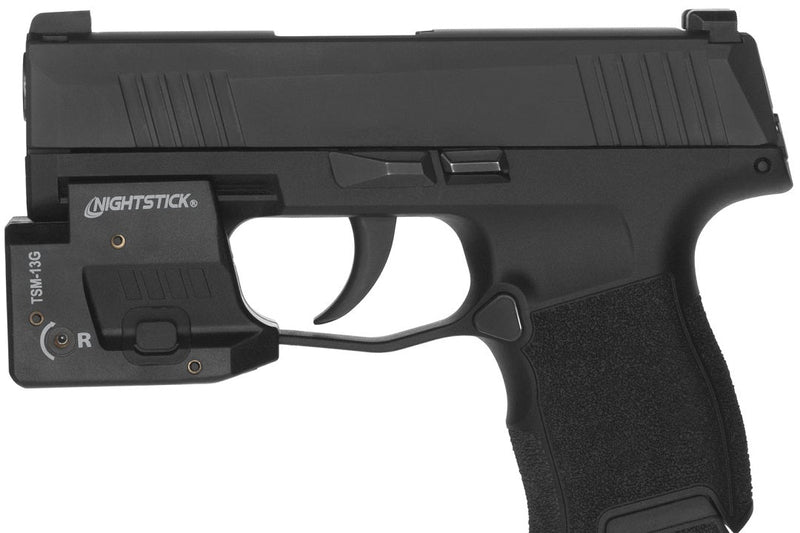
Weapon-mounted lights are designed for a narrow and purpose-driven role in low-light environments. They support illumination only after a lawful decision to present a firearm has been made.
-
Platform Aligned Illumination: Once a firearm is lawfully presented, mounted illumination tracks with the sights, supporting consistent lighting and controlled aiming during engagement.
-
One-Handed Operation: On a weapon-mounted light pistol, the support hand remains free for movement, communication, or stabilization when needed. Best practice is to maintain two hand control at all times.
-
Consistency Under Recoil: A properly mounted weapon flashlight maintains alignment and output through recoil, supporting visual continuity during repeated firing.
-
Nightstick Engineering Focus: Nightstick-mounted lights emphasize secure mounting, recoil resistance, and deliberate activation for controlled and professional use.
Handheld vs. Weapon-Mounted Lights: Which Is Right for You?
Misapplying illumination tools is a common training gap in low-light work. Using the wrong light for the task can increase risk, reduce control, and complicate post-incident evaluations.
-
Handheld Lights for Search & Assessment: Handheld lights support navigation and evaluation of unknown contacts without requiring a firearm to be drawn on unverified suspects.
-
Weapon-Mounted Lights for Post Identification Use: Mounted illumination supports aiming after lawful identification and should not replace the search process.
-
Professional Staging & Transition Practices: Many professionals stage both tools, using handheld illumination first and transitioning only when justified.
|
Category |
Handheld Lights |
Weapon-Mounted Lights |
|
Primary Purpose |
Search, navigation, and positive identification (PID). |
Aiming for support after the identification decision. |
|
Muzzle Independence |
Operates independently of firearm direction. |
Light is aligned with muzzle orientation. |
|
Best Use Stage |
Pre-identification and assessment phase. |
Post-identification and engagement readiness. |
|
Navigation & Movement |
Safer for room clearing and movement. |
Not ideal for general navigation tasks. |
|
Training Focus |
Grip techniques and situational awareness. |
Activation discipline and muzzle control. |
|
Professional Setup |
Often, the primary tool for search tasks. |
Commonly paired with a handheld for layered use. |
Handheld vs. Weapon-Mounted Lights: What are the Training and Techniques Considerations?
Illumination tools are only effective when supported by proper training and repeatable technique. Skill development ensures lighting enhances awareness and control rather than becoming a distraction under stress.
-
Handheld Light Technique Fundamentals: Users must train grip, light placement, and movement while maintaining situational awareness to support controlled information gathering.
-
Disciplined Mounted Light Activation: With weapon-mounted lights, activation timing and intent must align with decision thresholds and muzzle discipline.
-
Cross-Platform Operational Consistency: Nightstick maintains a similar switch feel and activation logic across models to reduce training friction and improve transitions.
Handheld vs. Weapon-Mounted Lights: Durability, Output, and Compliance
Within the 2A market, illumination tools are evaluated on reliability, consistency, and real-world performance. Equipment must withstand physical stress while delivering usable light without introducing unnecessary complexity.
-
Structural Integrity Under Use: A weapon flashlight must function reliably through recoil, impact, and environmental exposure to support operational continuity.
-
Balanced Beam & Output Control: Excessive spill or narrow beams reduce usable information. Nightstick balances candela and flood for practical identification.
-
Compliance-Focused Design Approach: Nightstick prioritizes realistic and application-driven output over exaggerated claims, aligning with industry standards.
How Do Professionals Choose the Right Light Configuration?
Choosing between Handheld vs. Weapon-Mounted Lights depends on role, environment, and training commitment. The most effective setups support task separation, disciplined use, and repeatable technique.
-
Home Defense & Residential Use: Many users prioritize handheld lights to search and assess without premature muzzle presentation, supporting safer movement in confined spaces.
-
Professional & Duty-Oriented Applications: Users running a weapon-mounted light pistol often pair it with a handheld option to maintain task separation and controlled transitions.
-
System-Based Equipment Planning: Nightstick’s ecosystem supports layered illumination setups, allowing professionals to select complementary tools for real-world use.
Key Takeaways on Responsible Illumination
Effective illumination supports awareness, control, and accountability in low-light environments. Understanding Handheld vs. Weapon-Mounted Lights helps professionals select tools that reinforce disciplined technique and lawful decision-making rather than shortcuts under stress.
Nightstick’s emphasis on ergonomic design, controlled output, and features such as LIGHT FINDER® reflects the expectations and scrutiny of today’s 2A community. These design priorities support intentional use and consistency across real-world conditions.
For users evaluating or configuring illumination tools, connecting with the Nightstick support team provides application-specific insight grounded in real-world use and industry standards. This guidance helps ensure equipment choices are informed, intentional, and aligned with professional requirements.
Frequently Asked Questions (FAQs)
What does PID mean in low-light contexts?
PID stands for Positive Identification. In low-light situations, it means clearly identifying a person or object before making any decision or action. Proper illumination ensures you understand what and who you’re seeing. It reduces the risk of misidentification.
What beam pattern is ideal for home defense?
A balanced beam with usable spill and controlled hotspot is ideal. This allows room awareness and threat identification without excessive glare or an overly narrow focus, which can limit peripheral information.
Are weapon-mounted lights safe for navigation?
Weapon-mounted lights are not intended for general navigation. Using them to move or search can result in unnecessary muzzle direction. Handheld lights are safer and more appropriate for navigation and initial assessment.
Do professionals commonly run both handheld and weapon-mounted lights?
Yes. Many professionals carry both tools, using a handheld light for search and assessment and transitioning to a weapon-mounted light only after a lawful identification decision. This layered approach supports a safer and more disciplined use.