
For firearms owners and professionals, choosing the best pistol light is about more than raw lumen numbers. The right light should support positive identification in low-light conditions, navigate low-light environments, and maintain control of your firearm under stress. It should also perform reliably during training, daily carry, and defensive use.
A dependable light must work with your grip, holster, and shooting style. Features such as switch placement, candela, runtime, and rail fit often matter more than headline output alone. Poor ergonomics can slow activation and make the light more difficult to use consistently under stress.
Whether you're setting up a concealed carry handgun, a duty pistol, or a home-defense firearm, selecting the right weapon-mounted light is critical. Explore Nightstick’s weapon lights to find a configuration that matches your platform, carry method, and intended role.
What is a Weapon-Mounted Light?
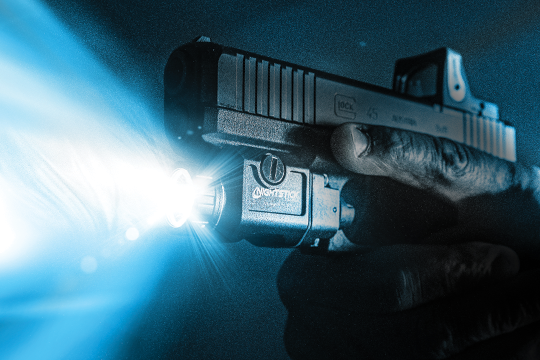
A weapon light is a dedicated illumination device designed to mount directly to a firearm’s accessory rail rather than being carried as a separate handheld flashlight.
By placing the beam in line with the firearm, the light naturally follows the direction of the muzzle, allowing target illumination and sight alignment to become one coordinated movement.
On handguns, this type of light is commonly referred to as a pistol light. These compact units mount forward of the trigger guard and are engineered to work with a normal firing grip while remaining compatible with properly designed holsters.
Why Weapon-Mounted Lights Matter
A weapon-mounted light offers several advantages over a handheld flashlight in certain defensive or duty applications.
Handheld Flashlight
-
Requires a separate support-hand technique.
-
Forces you to manage two tools independently.
-
Can divide attention during low-light or high-stress situations.
Weapon-Mounted Light
-
Keep the beam aligned with the firearm.
-
Allows activation without breaking your firing grip.
-
Simplifies low-light operation and target identification.
With a properly mounted light, the beam generally follows the direction of the firearm, reducing unnecessary hand movement and simplifying low-light operation. For many shooters, that means faster target identification, better control, and fewer compromises when operating under stress.
The key takeaway is that a weapon-mounted light isn’t just a flashlight attached to a gun. It’s a purpose-built component designed to integrate with the firearm, support a consistent shooting grip, and improve low-light performance in training, duty, and defensive use.
Why Every Defensive or Duty Pistol Needs One
Many defensive and law enforcement encounters occur in reduced-light conditions. Without proper illumination, positive identification (PID) becomes guesswork, and guesswork has no place in a defensive or duty context. A quality weapon-mounted light helps you identify what is in front of you before making any decision to act.
Beyond identification, a mounted light also improves speed and control. It reduces the time needed to build a usable sight picture in the dark and allows you to keep both hands on the firearm instead of managing a separate handheld light.
That is why many experienced shooters consider a weapon light part of the overall fighting setup, not just an accessory.
What a Weapon-Mounted Light Provides
- Positive Identification (PID): Support positive identification before making a defensive decision.
- Faster Target Acquisition: Build a usable sight picture more quickly in low-light conditions.
- Two-Handed Control: Keep your support hand on the firearm for better stability and recoil management.
- Reduced Task Overload: Eliminate the need to coordinate a separate flashlight while operating the handgun.
For concealed carriers, patrol officers, and home-defense shooters alike, mounted illumination can be an important part of a low-light firearm setup. It’s a critical component of how the firearm is intended to function after dark, and it deserves the same level of consideration as the handgun, sights, and holster that support it.
Weapon Light vs. Handheld Flashlight: Do You Need Both?
Rather than competing with each other, a weapon-mounted light and a handheld flashlight complement one another.
The handheld light is better suited for everyday searching and identifying people or objects, while the weapon light is intended for moments when the firearm is already in use and immediate illumination is required.
Keeping both tools available gives concealed carriers, duty users, and home-defense shooters greater flexibility and better low-light capability.
| Handheld Flashlight | Weapon-Mounted Light |
|---|---|
| Search rooms, hallways, or outdoor areas | Illuminate while the firearm is presented |
| Check IDs, noises, or unknown situations | Support positive target identification |
| Signal or communicate | Maintain a full firing grip |
| Use without pointing a firearm | Keep both hands available for recoil control |
| Best for low-risk illumination | Best for defensive or duty-ready use |
What Makes the Best Pistol Light? Key Features to Compare
Choosing the best pistol light isn’t simply about finding the highest lumen rating. Output, beam performance, runtime, switch design, durability, and firearm fit all play a role in how effectively a light performs when you need it.
Before choosing a model, compare these key features:
Output: Lumens and Candela
Lumens indicate the total amount of light produced, while candela describes the intensity of the beam and its ability to reach farther distances.
For defensive and duty applications, consider:
- Lumens: Provide broad illumination for rooms and nearby areas.
- Candela: Helps maintain beam intensity at greater distances.
- Balanced Output: Combines useful flood illumination with enough intensity for identification at a distance.
- Application: Higher output isn't automatically better; choose performance that matches your environment and intended use.
Nightstick offers handgun lights across multiple output levels, including compact options designed for different handgun platforms.
Beam Pattern: Spill vs. Throw
Brightness is only part of the equation. The beam pattern determines how effectively that light is distributed.
- Throw: A focused hotspot helps illuminate objects at greater distances.
- Spill: A wider surrounding beam provides broader illumination and peripheral awareness.
- Balanced Beam: Provides a focused center beam with enough surrounding illumination for versatile low-light visibility.
A beam that is too narrow may limit awareness around the edges, while excessive spill can reduce useful intensity at a distance. A well-designed pistol light balances both.
Runtime and Battery Type
Battery choice affects both performance and convenience. Compact lithium batteries such as CR123 cells can provide substantial output in a small package, while rechargeable systems can simplify regular training and maintenance.
Consider:
- Expected runtime
- Battery availability
- Rechargeable vs. replaceable power
- How often the light will be trained with or carried
- Whether spare batteries are easy to keep available
The right choice depends on your application and maintenance routine, not simply the battery type.
Switch Type and Placement
A switch should be easy to reach without forcing you to change your firing grip. Ambidextrous controls can also make activation more consistent for different users and shooting positions.
Look for:
- Natural thumb access
- Ambidextrous controls
- Momentary and constant-on options
- Consistent activation
- Minimal grip disruption
Before relying on a setup, practice activating the light during dry-fire and other unloaded handling drills. If reaching the switch causes your grip to shift, any ergonomic issue is likely to become more noticeable under stress.
Nightstick's TCM Series, for example, uses intuitive switch designs and is available for a wide range of handgun platforms.
Durability and Recoil Resistance
A weapon-mounted light experiences repeated recoil and vibration, so construction matters. Look for a housing designed to withstand regular range use, duty applications, and the demands of your particular firearm.
Important considerations include:
- Housing material
- Recoil resistance
- Water and environmental protection
- Switch durability
- Overall construction quality
Nightstick's weapon-light lineup includes models constructed from materials such as aircraft-grade 6061-T6 aluminum, depending on the model.
Rail and Holster Fit
Even the best weapon light is the wrong choice if it doesn't properly fit your handgun or holster.
Before buying, always confirm:
- Rail Compatibility: Make sure the light matches your handgun's accessory rail.
- Firearm Compatibility: Verify the exact make and model.
- Holster Compatibility: Confirm that your preferred holster supports the specific light.
- Overall Dimensions: Check the light's length and width against your setup.
- Mounting Hardware: Make sure the required inserts or mounting components are included or available.
Nightstick's LIGHT FINDER® allows users to select a firearm make and model to identify compatible weapon-light options, making fit verification easier before purchasing.
Matching Your Weapon Light to the Right Platform
Choosing the right weapon light starts with the firearm it will be mounted on. A pistol light has different size, mounting, and holster requirements than a rifle or shotgun light. Nightstick's weapon lights are organized by platform, making it easier to narrow your options based on your firearm and intended application.
Handguns
For handguns, fit and compatibility come first. A compact handgun light can reduce added bulk while maintaining a clean profile for holster use.
Before choosing a model, check:
- Rail Compatibility: Confirm the light fits your handgun's specific accessory rail.
- Holster Compatibility: Make sure your existing or preferred holster supports the light.
- Overall Size: Consider how the light affects the pistol's profile and carry setup.
- Switch Placement: Choose controls that are easy to reach without disrupting your grip.
If you change your light or handgun, re-check the complete setup rather than assuming your existing holster will remain compatible.
Rifles and Carbines
Rifles and carbines give you more flexibility when positioning a light, but mounting location can significantly affect usability. Nightstick's rifle and carbine lights are designed for these platforms and provide options for different mounting and activation requirements.
When selecting a rifle or carbine light, be sure to consider:
- Mounting Position: Place the light where it provides a clear beam without interfering with other accessories.
- Switch Access: Make sure the activation control is naturally reachable from your support-hand position.
- Beam Performance: Consider how much close-range spill and distance-focused throw your application requires.
- Balance: Avoid unnecessary bulk that could affect how naturally the rifle handles.
Shotguns
Shotguns generate significant recoil, making durability and mounting security especially important. Nightstick's shotgun forend lights are designed specifically for shotgun applications and integrate illumination into the forend.
When selecting a shotgun light, consider:
- Recoil Resistance: Choose a light designed to withstand repeated cycling and recoil.
- Forend Compatibility: Make sure the light works with your specific shotgun configuration.
- Pump Clearance: Confirm that the light doesn't interfere with normal pump operation.
- Switch Accessibility: The controls should remain easy to activate during normal manipulation.
Choosing the Best Weapon Light for Your Role
The right weapon light depends on more than specifications alone. Your firearm, environment, carry method, and intended use all influence which features matter most. A patrol officer may prioritize durability and duty compatibility, while a concealed carrier may place greater emphasis on size and holster fit.
Law Enforcement and Armed Security
Duty professionals need a weapon-mounted light that can withstand extended use, repeated training, and demanding conditions. Compatibility with department-approved holsters is also essential, particularly when the light and holster are part of an established duty setup.
When choosing a light for professional use, consider:
- Durability: Look for construction designed to withstand regular recoil and daily use.
- Reliable Controls: Activation should be intuitive and consistent under stress.
- Holster Compatibility: Confirm the light works with your approved duty holster.
- Output and Beam: Choose illumination suited to both indoor and outdoor environments.
- Battery Management: Consider runtime and how easily batteries can be replaced or maintained.
Nightstick's law enforcement lineup includes lighting solutions designed for professional applications and demanding operational environments.
Concealed Carry
For concealed carriers, size and compatibility become especially important. A compact pistol light can provide useful illumination while minimizing additional bulk that may affect concealment, comfort, or draw mechanics.
Be sure to look for:
- Compact Dimensions: Reduce unnecessary bulk around the handgun.
- Holster Availability: Verify that compatible carry options are available.
- Easy Activation: Controls should be accessible without significantly changing your grip.
- Adequate Output: Choose enough illumination for your typical carry environment.
- Secure Mounting: The light should remain firmly attached during regular carry and training.
The best weapon light for concealed carry is ultimately the one that balances illumination, reliability, size, and compatibility with your complete carry system.
Home Defense
A home-defense handgun may benefit from a weapon-mounted light that provides broad, useful illumination across rooms, hallways, and other close-range areas. Indoor environments can vary significantly in size and lighting, so beam quality is just as important as raw output.
When evaluating a home-defense setup, consider:
- Broad Illumination: Helps provide useful visibility at close indoor distances.
- Beam Balance: Look for a combination of central intensity and surrounding spill.
- Simple Controls: Activation should be straightforward and predictable.
- Reliability: Choose a light designed to remain dependable when stored and periodically tested.
- Firearm Compatibility: Confirm proper rail and holster compatibility for your specific handgun.
There is no single best weapon light for every shooter. A professional duty setup, concealed carry handgun, and home-defense firearm can each require a different balance of size, output, controls, durability, and compatibility.
Choose a weapon light based on your firearm and how you plan to use it, then compare features within that category. This helps ensure your light complements your setup instead of creating unnecessary compromises.
Common Mistakes to Avoid When Buying a Weapon Light
Choosing a weapon light based only on specifications can lead to compatibility and usability issues later. Before buying, consider how the light will perform once it's mounted, holstered, and used with your firearm.
- Selecting based on Lumens Alone: High lumen output doesn't always mean better performance. Consider candela, beam distance, and overall beam pattern too.
- Skipping Holster Verification: Always confirm that your chosen light is compatible with your holster. Re-check compatibility whenever you change the light or carry setup.
- Ignoring Rail Compatibility: Make sure the light securely fits your pistol's accessory rail. Even small compatibility issues can affect mounting and overall reliability.
- Overlooking Switch Ergonomics: Controls should be easy to reach without unnecessarily changing your firing grip. Practice activation to make sure the switch placement feels natural.
- Skipping Hands-on Testing: Before relying on a new light for carry or duty use, test the complete setup through unloaded handling, dry-fire practice, and low-light drills.
Find the Right Nightstick Weapon Light for Your Setup
Nightstick designs weapon-mounted lights for law enforcement, armed security, first responders, and responsible firearm owners. From compact handgun lights to rifle and shotgun solutions, each platform is built around reliable illumination, practical controls, and secure mounting.
Why Choose Nightstick?
- Professional-Focused Design: Built for demanding duty, training, and defensive applications.
- Platform-Specific Options: Choose from solutions for handguns, rifles, carbines, and shotguns.
- Durable Construction: Designed to withstand recoil and regular use.
- Intuitive Controls: Switch placement supports quick and consistent activation.
- Reliable Illumination: Balanced output helps support low-light identification and awareness.
Not sure which model matches your firearm? Nightstick can help narrow down compatible lighting options based on your platform. Use it to identify suitable lights for your specific firearm before comparing output, mounting configuration, and other features.
Whether you're outfitting a concealed carry pistol, duty sidearm, rifle, or home-defense setup, choosing the right weapon light starts with compatibility. Use Nightstick's LIGHT FINDER® to narrow your options or get in touch with our experts for assistance.
Frequently Asked Questions (FAQs)
How do I know which Nightstick light fits my specific handgun?
Use Nightstick’s LIGHT FINDER® to identify compatible lighting options for your specific handgun model. This helps narrow your choices before comparing features, mounting configurations, and intended applications.
Can I use the same weapon light on multiple handguns?
Not necessarily. Compatibility depends on the firearm’s rail configuration, light design, and available mounting hardware. Always verify compatibility for each handgun and confirm that a suitable holster is available before switching a light between platforms.
Should I leave my weapon light installed when storing my handgun?
Follow the storage recommendations for your specific firearm and light. For lights with a battery-safe or lockout feature, using that function can help prevent unintended activation and unnecessary battery drain during storage or transportation.
Is a strobe feature important on a weapon-mounted light?
A strobe is an optional feature rather than a requirement for every user. If you prefer a model with this capability, look for controls that allow predictable activation and, when available, the ability to enable or disable the function based on your preferences and training.
What should I do after installing a new weapon light?
Confirm that the light is securely mounted, verify holster compatibility, check the controls, and conduct appropriate unloaded handling and low-light training before relying on the setup. Recheck the mounting hardware periodically, particularly after repeated range use.
What is the difference between a pistol light and a weapon-mounted light?
A pistol light is a type of weapon-mounted light designed specifically for handguns. The broader term includes lights made for pistols, rifles, and other platforms. Pistol lights are typically compact and designed to fit the firearm's rail while maintaining compatibility with the appropriate holster.